Get Quote
Near-Surface Geophysics · Passive Method

Magnetics &
Magnetic Gradiometry

Total-field and vertical-gradient surveys for ferrous object detection, geological boundary mapping, UXO/UST localisation, landfill characterisation and archaeological investigation.

0.01 nT
GSM-19 Sensitivity
Overhauser
Sensor Technology
Passive
No Source Required

Measuring Earth's
Magnetic Field

Magnetic surveying measures spatial variations — anomalies — in Earth's ambient magnetic field caused by contrasts in the magnetic susceptibility of subsurface materials. Ferrous objects, magnetite-bearing geology and thermally altered soils all generate measurable field perturbations superimposed on the regional geomagnetic background.

SGC operates the GEM Systems GSM-19 Overhauser magnetometer — one of the most sensitive and stable total-field sensors available for near-surface work. The Overhauser effect provides continuous, absolute field measurements without the heading errors, warm-up drift or polarisation dependency that affect fluxgate and proton precession sensors.

Surveys are conducted in total-field or vertical-gradient gradiometer configuration. Gradiometry measures the rate of change of the field with height, dramatically suppressing regional gradients and enhancing near-surface targets — the preferred configuration for archaeological and UXO applications.

Instrument
GEM Systems GSM-19
Overhauser Magnetometer
Sensor TypeOverhauser Effect
Sensitivity0.01 nT RMS
Absolute Accuracy0.1 nT
Reading RateUp to 5 Hz
Operating Range20,000 – 120,000 nT
Gradient ModeDual sensor, 1 m separation
GPS IntegrationInternal, synchronised
Base StationGSM-19W / WG compatible

The Overhauser sensor requires no heading corrections and produces no dead zones — unlike proton precession instruments — enabling continuous data collection at walking pace in any orientation.

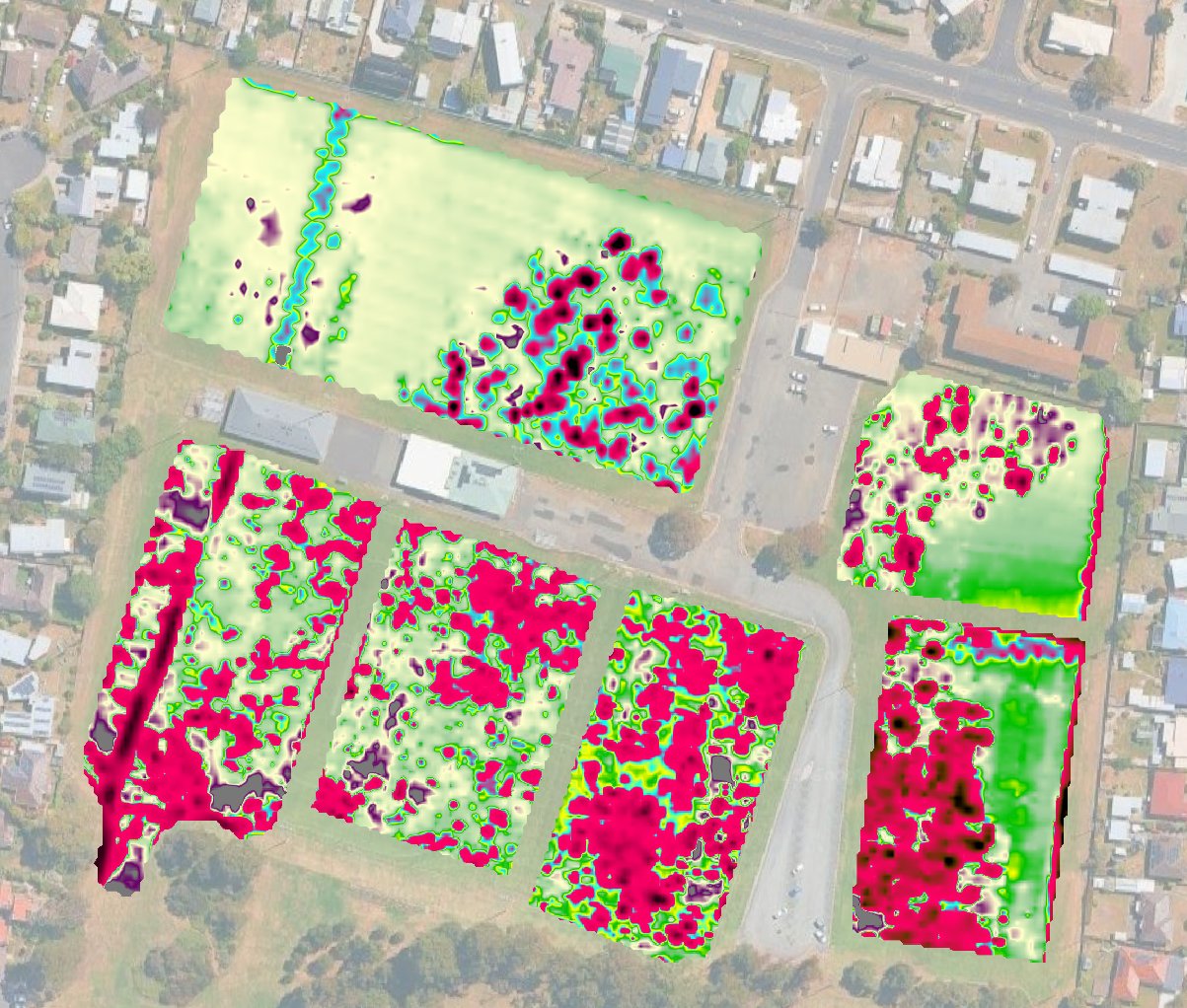
Urban Sports Centre
Gradiometry Survey

Multi-sports field magnetic gradiometry survey draped over aerial imagery. Dark dipolar anomalies indicate strong ferrous responses — buried metallic debris, underground storage tanks and service infrastructure.

Where Magnetics
Delivers

Magnetic surveys are highly cost-effective over large areas and require no ground contact — ideal for rapid site screening, followed by targeted investigation with complementary methods.

Heritage
Archaeological Investigation

Detection of fired features — hearths, kilns, burned structures — and ferrous artefacts including nails, tools and weapons. Thermally remanent magnetisation makes hearths among the strongest archaeological targets. Gradiometry resolves sub-metre features at traverse spacings of 0.25–0.5 m.

Environmental
Landfill Mapping

Delineation of buried waste extent, depth and internal composition. Ferrous debris generates intense, chaotic anomalies clearly distinguishable from background geology. Combined with EM surveys, magnetics defines both lateral boundaries and internal metallic content of uncharacterised legacy waste.

Safety
UXO & UST Detection

Unexploded ordnance and underground storage tanks are among the strongest magnetic targets — ferrous casings generate dipolar anomalies detectable at depth. Gradiometry isolates discrete point-source anomalies for targeted excavation in pre-construction clearance on former military and industrial land.

Geology
Geological Boundary Mapping

Mapping of intrusive contacts, fault zones, dykes and lithological boundaries where magnetic susceptibility contrast exists. Mafic intrusives and magnetite-bearing units generate broad, high-amplitude anomalies used to extend geological mapping beyond outcrop.

Forensics
Buried Firearms & Metallic Evidence

Systematic high-resolution gradiometry for forensic search of buried ferrous evidence — weapons, vehicles, drums and containers. Covers large areas rapidly as the primary screening tool before targeted metal detection or excavation.

Infrastructure
Buried Ferrous Utilities

Detection of cast iron and steel pipelines, well casings and buried infrastructure — complementing GPR and EM utility locating where pipes are large, deep or obscured by conductive fill. Dipole modelling provides depth estimates without excavation.

What Creates
a Magnetic Anomaly?

Induced
Ferrous metal
Steel, cast iron — strongest near-surface targets. USTs, drums, pipelines, ordnance, vehicles.
Remanent
Fired ground
Thermally remanent magnetisation in hearths, kilns, burned structures — key archaeological target.
Induced
Mafic geology
Basalt, dolerite, magnetite-bearing units — broad regional anomalies used in geological mapping.
Contrast
Diamagnetic lows
Voids, cavities and non-magnetic fills produce subtle lows adjacent to strong magnetic sources.

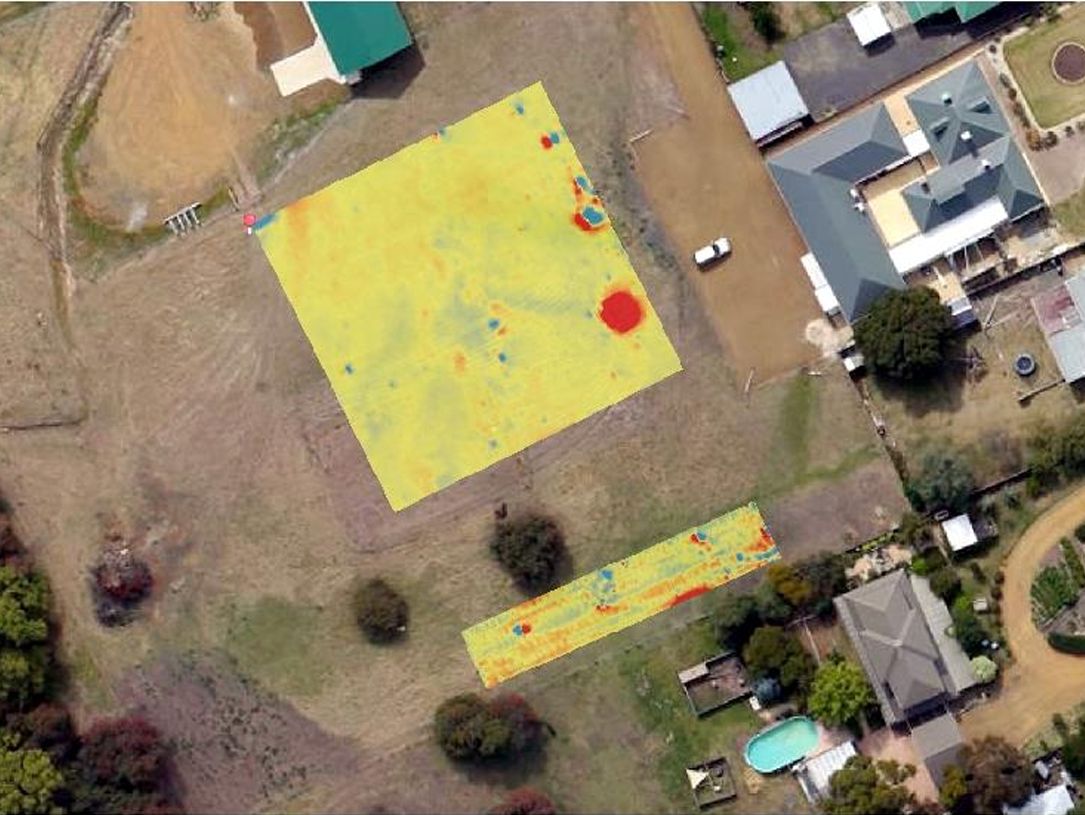
Kempton Manor
Archaeological Survey, Tasmania

High-resolution magnetic gradiometry at a colonial-era heritage property — detecting remnant structural features, fired ground and ferrous artefact concentrations within the curtilage of a listed historic building. Survey grid 0.5 m line spacing, 0.25 m traverse spacing.
Survey Output
Kempton Manor — South Side
Kempton Manor magnetic gradiometry survey — south side
High-density gradiometer data revealing large circular anomalies consistent with buried remains from historical activity.

Areas We
Serve in Tasmania

Spaulding Geophysics provides ground magnetic surveys across Tasmania, from Hobart and Launceston to regional centres, coastal towns, and remote communities statewide.

South & Greater Hobart
  • Hobart
  • Kingston
  • Margate
  • Kettering
  • Bruny Island
  • New Norfolk
  • Sorell
  • Dodges Ferry
North & Launceston
  • Launceston
  • George Town
  • Longford
  • Perth
  • Hadspen
  • Westbury
  • Deloraine
  • Bridport
Northwest Coast
  • Devonport
  • Burnie
  • Ulverstone
  • Wynyard
  • Penguin
  • Smithton
  • Latrobe
  • Port Sorell
East Coast & Midlands
  • Bicheno
  • St Helens
  • Scottsdale
  • Swansea
  • Campbell Town
  • Ross
  • Queenstown
  • Huonville

Spaulding Geophysics delivers on-site ground magnetic surveys across all of Tasmania — including Hobart, Launceston, Devonport, Burnie, Ulverstone, George Town, Longford, Deloraine, Smithton, Wynyard, Bicheno, St Helens, Scottsdale, Queenstown, Huonville, Kingston, Kettering, Bruny Island and surrounding communities. Remote and regional sites welcomed.