Concrete Corrosion Mapping
Tasmania
Half-cell potential, electrical resistivity and moisture assessment — mapping corrosion probability across reinforced concrete structures.
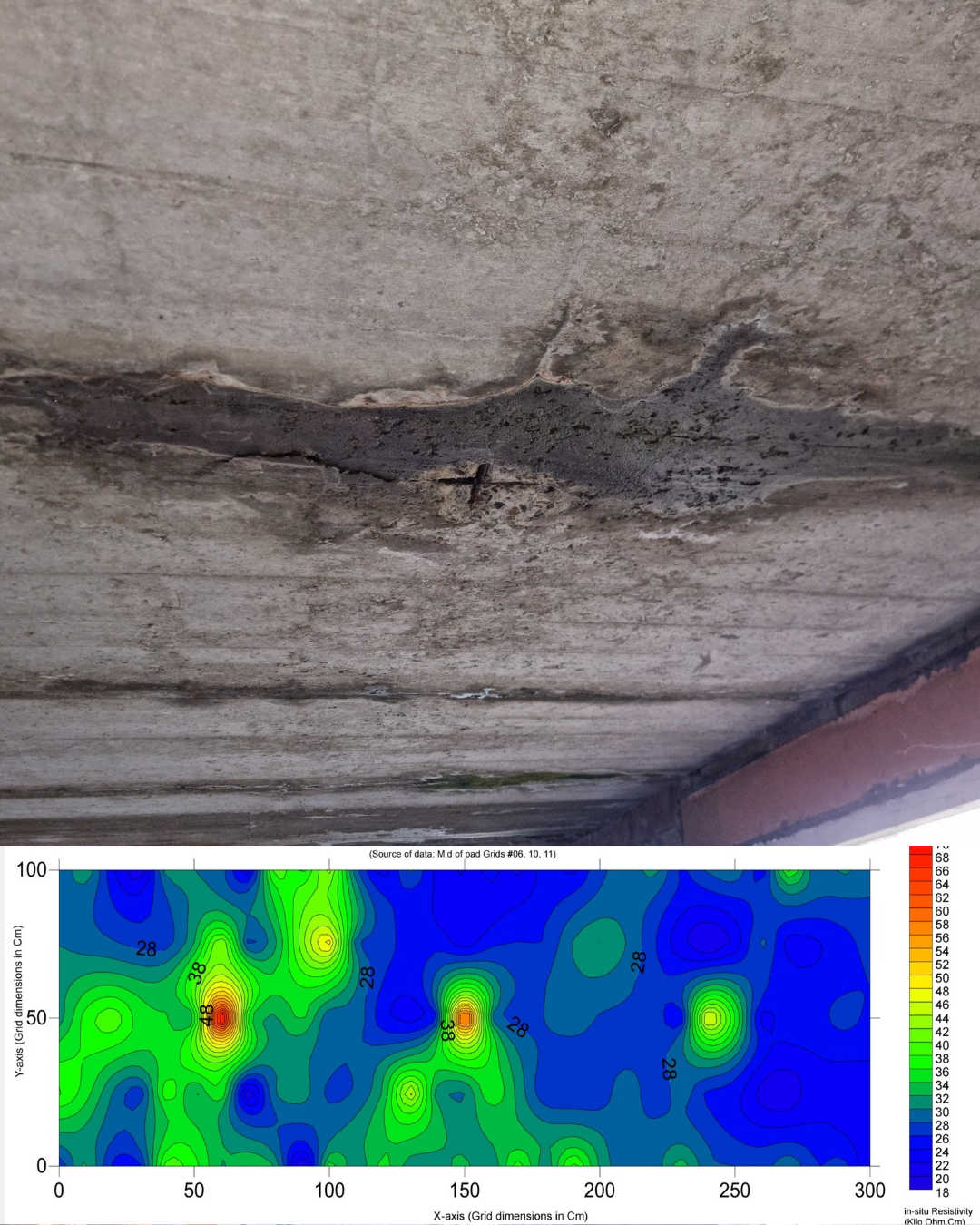
Concrete Corrosion Mapping & Half-Cell Testing:
Electrochemical Rebar Degradation Analysis Tasmania
Concrete corrosion testing evaluates the structural integrity of reinforced concrete assets for quality control, compliance verification, and degradation risk assessment. Our diagnostic programs at Spaulding Geophysics are tailored to exact project objectives, focusing on the key electrochemical and physical indicators of reinforcement corrosion across Tasmania.
We combine three complementary non-destructive methods—half-cell potential mapping (ASTM C876), concrete electrical resistivity testing, and surface moisture assessment. By correlating these datasets, our geophysicists build a spatially resolved corrosion probability map. This advanced diagnostics model enables civil engineers to pinpoint active rebar degradation, conduct targeted investigations, and implement prioritised structural remediation.
This comprehensive corrosion analysis is critical for managing aged infrastructure, commercial concrete assets, and coastal developments exposed to harsh environments. Spaulding Geophysics delivers this expert diagnostic testing for bridges, wharf structures, and industrial assets spanning Hobart, Launceston, Devonport, Burnie, and regional Tasmania.
Three Methods,
One Complete Picture
Each method contributes a distinct dataset. Combined, they eliminate ambiguity in corrosion probability assessments and enable confident, defensible risk classification.
Half-Cell Potential Testing
Measures the electrical potential between reinforcing steel and a surface reference electrode. More negative readings indicate a higher probability of active corrosion, enabling efficient spatial mapping of corrosion-prone areas within a structure.
| Half-Cell Potential (mV vs CSE) | Corrosion Probability |
|---|---|
| More positive than −200 mV | Low — <10% chance of active corrosion |
| −200 mV to −350 mV | Uncertain — corrosion activity uncertain |
| More negative than −350 mV | High — >90% chance of active corrosion |
Electrical Resistivity Testing
Evaluates the concrete's resistance to ionic flow — strongly influenced by moisture content and pore-network permeability. Lower resistivity values are associated with increased corrosion risk and identify zones where environmental conditions favour reinforcement deterioration.
| Resistivity (kΩ·cm) | Corrosion Risk |
|---|---|
| > 950 kΩ·cm | Low |
| 400–950 kΩ·cm | Moderate |
| 220–400 kΩ·cm | High |
| < 220 kΩ·cm | Very High |
Moisture Assessment
Quantifies the presence of water within the concrete matrix, providing critical context for interpreting electrochemical test results. When combined with half-cell and resistivity data, moisture measurements improve confidence in corrosion risk evaluations and help explain spatial patterns in the mapped results.